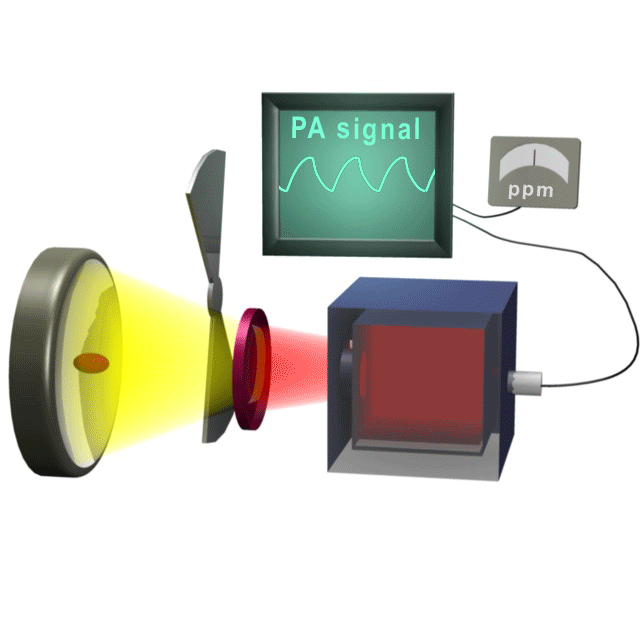
Photoacoustic spectroscopy (PAS) is based on the absorption of modulated infrared light leading to the local warming of the absorbing gas volume element. The generated pressure waves are detected by a pressure detector (i.e. microphone) producing signal proportional to the absorption.
Conventional photoacoustic infrared spectroscopy with mechanical chopper and optical filters
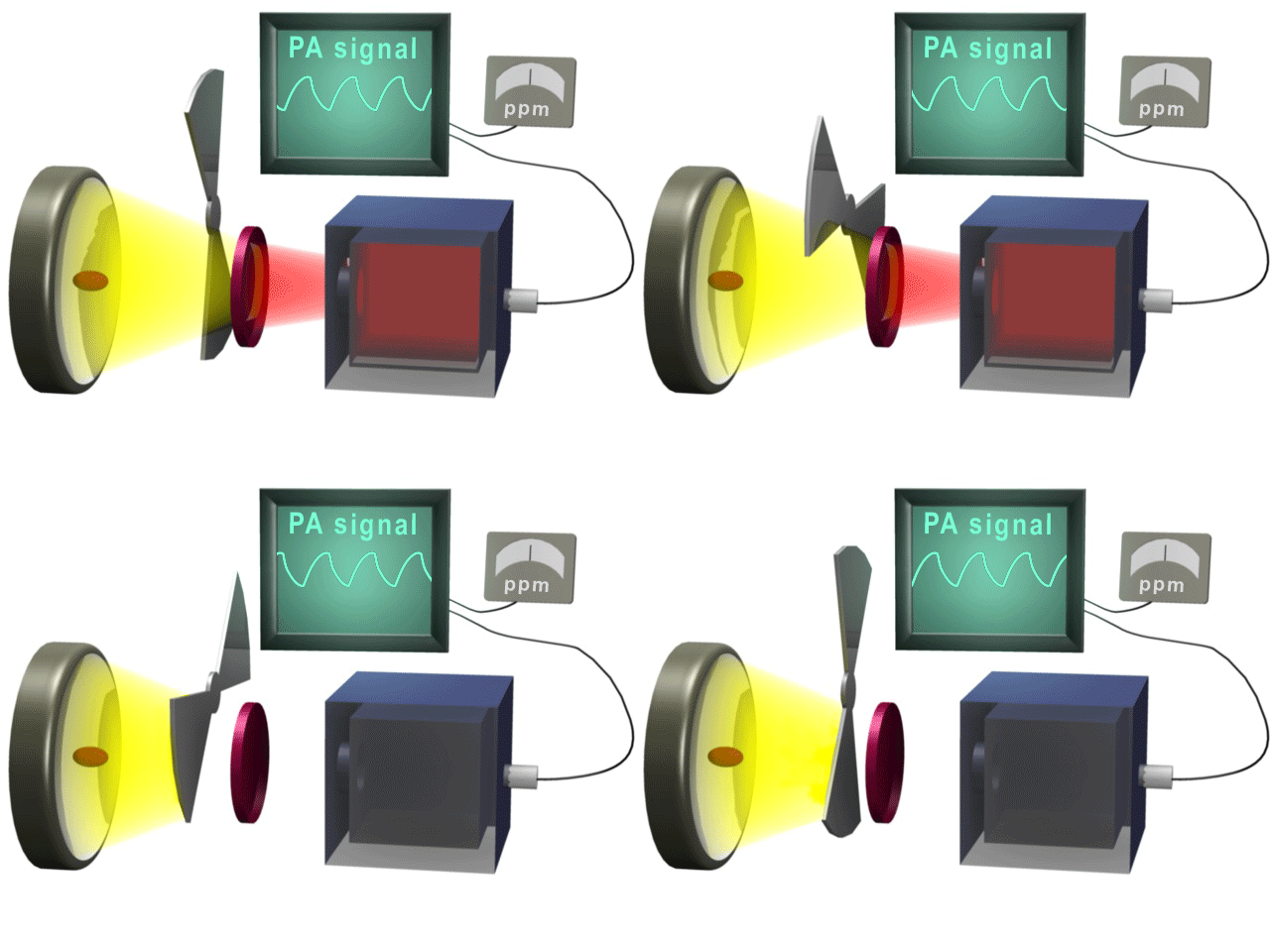
In a conventional photoacoustic spectroscopy (PAS) setup, the gas to be analyzed is sealed inside a measurement chamber and exposed to modulated light at a specific, pre-selected wavelength. After passing through a light chopper and an optical filter, the infrared radiation is focused with a mirror onto the window of the photoacoustic chamber.
The optical filter is typically a narrow-band infrared interference filter, chosen according to the absorption band of the target gas. When the concentration of the target gas inside the chamber increases, a greater portion of the infrared light is absorbed, resulting in a stronger photoacoustic signal.
Photoacoustic infrared spectroscopy for multi-gas analysis
For the simultaneous analysis of multiple gas compounds in a complex mixture, a set of optical filters is mounted on a filter wheel. High selectivity is achieved by carefully choosing several filters with narrow spectral bands, targeting both the gases of interest and any potential interfering gases. The analysis is then performed by applying a least squares fit, comparing the optical filter response data to the calibration data of the pure gas compounds.
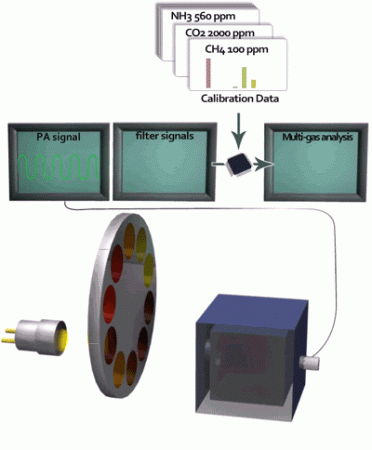
A mathematical model based non-linearity compensation is applied to all filter responses which expands the linearity range to over 100 000 times the detection limit using only one point span calibration!