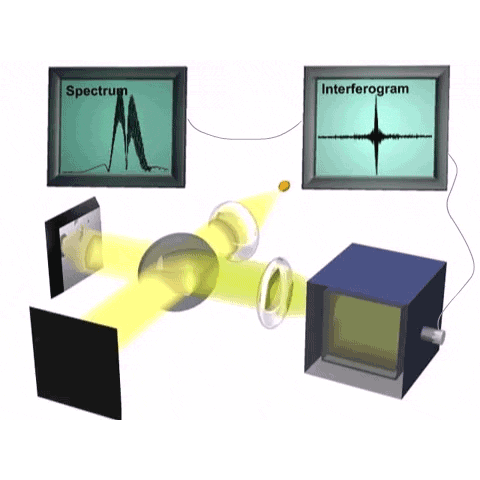
FTIR is a widely used method for obtaining IR spectra of a sample. The sample is exposed to IR radiation modulated by an interferometer and the intensity of transmitted radiation is monitored via an IR detector. At certain resonant frequencies characteristic of the specific sample, the radiation will be absorbed resulting in a series of peaks in the spectrum, which can then be used to identify the sample.
Gasera has improved the sensitivity of gas phase FTIR significantly by combining FTIR principles with photoacoustic spectroscopy (FTIR-PAS). This technology can also be applied to solid, semi-solid and liquid samples.
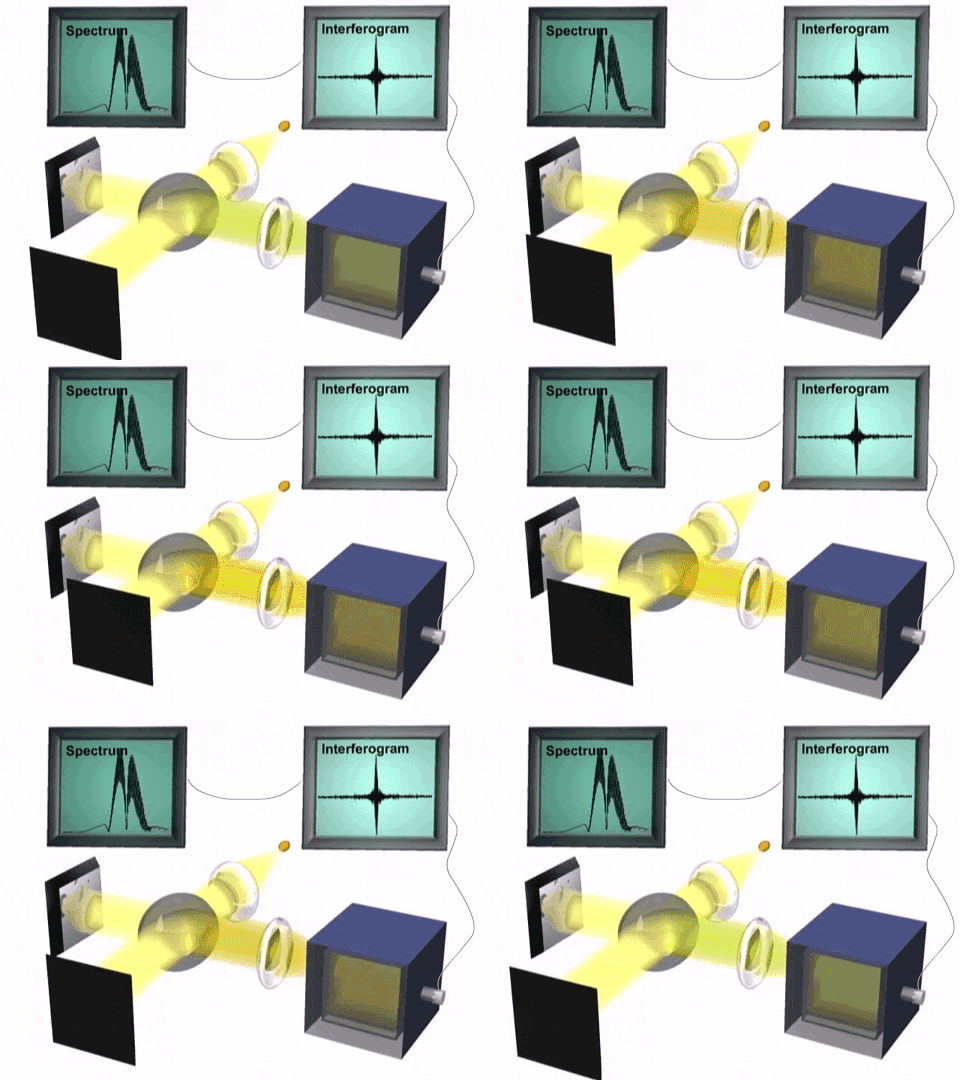
Gas phase photoacoustic FTIR is based on the absorption of modulated light leading to the local warming of the absorbing volume element. The generated pressure waves are detected by a sensitive pressure detector producing a signal proportional to the absoption.
KEY ADVANTAGES
In comparison to an absorption spectrometer (conventional FTIR) a significantly smaller sample cell can be used. Therefore, small sample gas volumes are needed and the whole device is smaller. This makes it ideal for compact portable and hand-held instruments.
The short optical path length brings about other advantages, in particular the high linearity of response of the measured signal. Linearity is advantageous for measuring the analyte response accurately and for accurately subtracting the signals from any interfering gases, in particular, from water and CO2. This feature is very important when measuring industrial exhaust gases, which usually contain high levels of water vapour.
INNOVATION
Gasera’s patented optical cantilever sensor offers an exceptionally wide dynamic range. Combined with the linear response, this opens the door to advanced applications, such as monitoring before-and-after scrubber performance in industrial processes.
With the novel silicon cantilever sensor, the sample cell can be heated up to 200°C, which is necessary for many industrial emission applications. These advantages make photoacoustic FTIR a highly promising technique for industrial gas esmission measurements across a wide range of fields.